This is a summary of the main findings of the Quine Report. You can download this executive summary as a .pdf or .doc, and also download the full report as a .pdf or a .doc.
Introduction
- This project examines whether women are at a disadvantage in the contemporary Scottish literary sector and how we can move towards a more equitable future.
- To do this, I conducted interviews with tastemakers leading Scottish literary organisations, and counted the authors’ gender in books published, books reviewed, festival events (2017-2019), and prizes won (1919-2024).
- I first did this research as part of a PhD thesis across several institutions, including the University of Stirling, the University of Glasgow, and Scottish Book Trust, from 2017-2023. The work was funded by a Creative Economies Studentship from the Scottish Graduate School for Arts and Humanities (SGSAH) and the Arts and Humanities Research Council (AHRC). This report is a summary of my main findings.
The Numbers
Literary prizes: 1919-2024
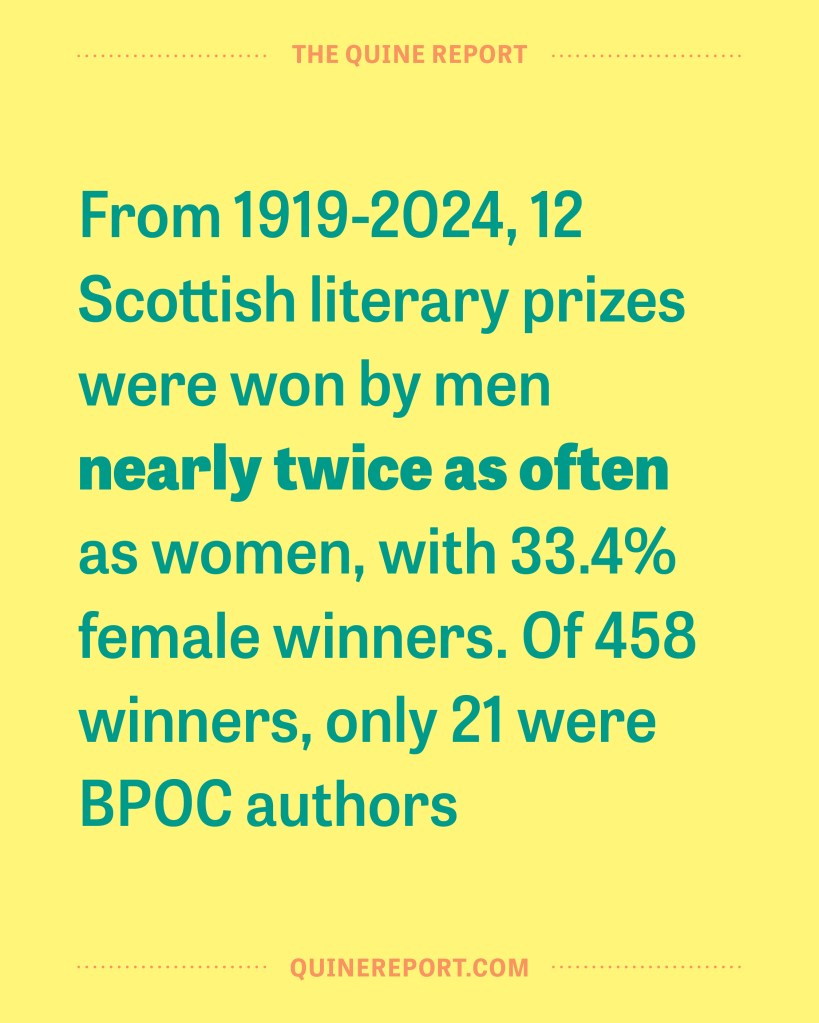
- From 1919-2024, 12 Scottish literary prizes were won by men nearly twice as often as women. There were 302 (65.9%) male winners, 153 (33.4%) female winners, and 3 (0.7%) non-binary winners.
- Of the 458 winners over this time period across these 12 prizes, only 21 (4.6%) winners were BPOC[1] authors: 8 men, 12 women and 1 non-binary writer. In 92 shortlists examined,[2] only 39 (7.8%) of 500 shortlisted authors were BPOC authors.
- The full report and its Appendix contain a decade-by-decade and a prize-by-prize breakdown of these figures.
Publishing
- Scotland-based publishers published male authors 50% more than female authors in the years 2017-2019. 1,237 (61.3%) male authors, 778 (38.6%) female authors, and 2 (0.1%) non-binary authors were published. No gender data was available for 67 authors.
- Men were the majority of authors in fiction, trade non-fiction, and poetry. Women were the majority of authors in children’s and young adult books. However, in non-fiction books for children and young people, men again were the majority of authors.
- A full list of publishers counted, and publications per category is in the Appendix.
Reviewing
- The Scotsman and The Herald reviewed male authors 1.7 times more than female authors in the years 2017-2019. 1,038 (62.6%) of total authors were male, 615 (37.1%) female and 4 (0.2%) non-binary. No gender data was available for 6 authors.
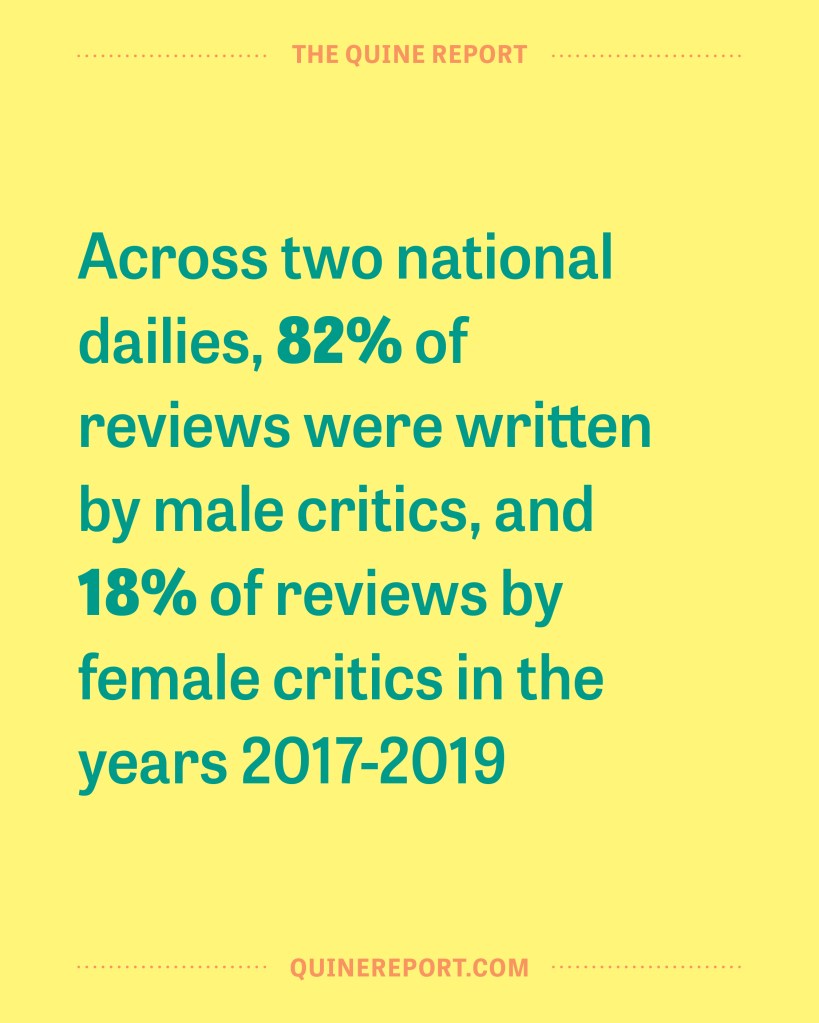
- Disparity was even more stark in book reviewers. 1,265 (82.0%) of reviews were written by male critics, 278 (18.0%) of reviews by female critics, and the dataset recorded no openly non-binary critics.[3] No gender data was available for 83 critics.
Book festivals: 2017-2019
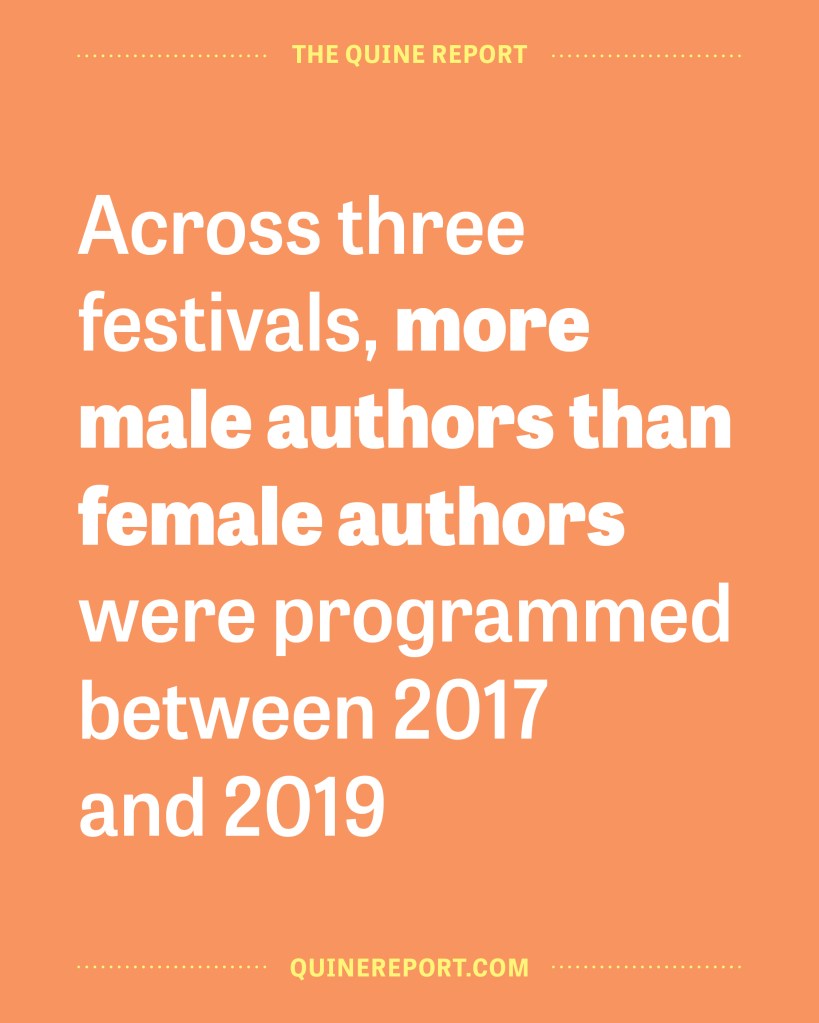
- Across three festivals – Edinburgh International Book Festival (EIBF), Aye Write and Bloody Scotland – more male authors than female authors were programmed between 2017-2019. 2,206 (52.8%) of authors programmed were male, 1,905 (45.6%) were female, and 18 (0.4%) were non-binary. No gender data was available for 52 authors.
- On average, at Aye Write and EIBF[4],the men programmed were more likely than the women to have a solo event: the gender disparity is an average of 7.2 points higher for solo events than the gender disparity for total events.
Amplifying Visibility
- From 2017-2019, 17 authors (of 1,321 individual authors published in Scotland) appeared in all four of the following areas: they were published in Scotland, received a review, spoke at a book festival, and were shortlisted and/or won a literary prize.
- Of these 17, 11 were men (64.7%) and 6 were women (35.3%). All 17 of these authors were white, meaning that this higher visibility was entirely unavailable to BPOC authors within this 3-year sample.
- The more an author appeared multiple times across the data – for example, both receiving a book review and winning a prize, or having four different festival events – the more likely they were to be white. The more visibility was amplified, the more BPOC were excluded.
The Interviews and Analysis
As well as counting disparity in Scottish literature, I interviewed 26 tastemakers in the industry (2018-2020). Interviewees spoke about working in literature, focussing on the late 2010s, but drawing on experience that went as far back as the 1980s. This report quotes 13 of these interviews directly, but the analysis is based on all of them and on wider research about inequality in literature. I found that:
- At several stages, ideas of what Scottish literature should or could be are limited. Firstly, the Scottish literary canon, which historically favours white male authors, still impacts tastemaking today.
- Secondly, ideas are limited by the capitalist market idea of risk, in which literary sector businesses appeal to imagined ideas of consumers. As Rethinking ‘Diversity’ in Publishing[5] shows, many publishers make decisions based on what their “imagined” reader wants, but that assumption does not represent the breadth of the UK reading market. These assumptions limit the books published by women and gender minorities.[6]
- Some of the literary festival directors interviewed felt they lacked complete agency and editorial control because of the complex network of market relationships between publishers, reviewers, festival programmers and prize judges.
- Two interviewees disclosed direct experiences of harassment and intimidation, and several more spoke of being treated less favourably due to their gender or ethnicity, or missing out on opportunities due to caring responsibilities.
- The work of women in the literary sector often happens in the background (i.e. they inhabit a structurally secondary role), or is otherwise devalued through gender stereotyping.
- The picture which emerges from interviews together with background research is one of an industry which is overwhelmingly staffed by women but which does not value the labour of women as highly as that of men.
- Women cannot alone be responsible for addressing inequality in the publishing industry. They hold little structural advantage and their capacity – their resources, energy and focus – is limited by the harassment and the devaluing they face.
- Structural imbalance has a real material impact on authors.
- Despite a countercultural self-image, the quantitative and qualitative data above show that literature is far from an equal industry.
- Several interviewees stated that tastemakers would be horrified if accused of sexism because they believe they have good intentions, and work in a countercultural sector. They may believe that their good intentions protect them from perpetuating sexism and from accusations of sexism. However, the data in this report show that sexism exists throughout the Scottish literary sector.
Industry recommendations
- TRANSPARENCY. Organisations, institutions and companies should conduct a regular audit of the demographics of authors they work with (e.g. through publishing, programming, shortlisting, receiving submissions etc.). Wherever possible, anonymised findings should be made public, including wages/wage bands, advances and royalties.
- INTEGRATING DIVERSITY. Organisations, institutions and companies should build equality, diversity and inclusion into their publishing, reviewing, platforming, submission and shortlisting processes, to empower decision-makers and all employees to question exclusionary practices.
- REPORTING GENDER-BASED HARASSMENT. The Scottish literary sector should implement systems for reporting gender-based harassment, intimidation, discrimination and violence.
[1] BPOC stands for Black people, People of Colour
[2] Other shortlists either were not available or lacked sufficient ethnicity data.
[3] Several reviews included books by more than 1 author, hence the discrepancy between total authors and total reviewers.
[4] Bloody Scotland programmed fewer than 10 solo events in this time period.
[5] Saha and van Lente, ‘Rethinking “Diversity” in Publishing’.
[6] I use “gender minorities” to describe transgender, intersex and/or non-binary people.
For detail on all the data, sources and methods, with a discussion of the interview material, please read the full report (pdf / doc).
Images for social media
You’re welcome to use the below images to share the headline findings on social media.


 The Quine Report